Strategy
Real Estate Branding: A Practical Guide for Agents and Teams
Published 2026-08-22 · By Launch & Found
A clear look at real estate branding: what it includes, what it costs, and how to build one that actually generates inbound leads.
Real estate branding is the consistent set of visual identity, messaging, and online presence that makes a specific agent or team recognizable and trustworthy to buyers and sellers in their market. It includes your logo and colors, but it also includes your website, your Google Business Profile, the way you write listing descriptions, and how you show up in search results when someone looks for an agent in your area. Done well, it makes the difference between being one of twenty similar-looking agents and being the obvious choice.
- What Is Real Estate Branding, Exactly?
- Why Does Branding Matter More for Real Estate Than Other Businesses?
- What Are the Core Elements of a Real Estate Brand?
- How Much Does Real Estate Branding Cost?
- Should You Build Your Brand Around Yourself or Your Team?
- FAQ
- Key takeaways
What Is Real Estate Branding, Exactly?
Most agents think branding means a logo and a business card. That is a small part of it. Branding is really the sum of every impression a prospective client forms before they ever speak to you: your listing photos, your website's first screen, the reviews under your Google profile, the tone of your emails, and the name people use when they refer you to a friend.
A brand answers three questions for a stranger in under 10 seconds: who is this person, what do they specialize in, and can I trust them with the largest financial decision of my year. If your online presence answers those questions clearly, the brand is working. If a visitor has to dig for your specialty, your area, or your track record, the brand is not doing its job, regardless of how polished the logo looks.
This is why branding and lead generation are not separate projects for real estate professionals the way they might be for a retail business. A confusing or generic brand quietly suppresses inbound leads, because people scroll past what they do not immediately understand. A clear one does the opposite: it lets your existing reputation and past sales work harder, because visitors can quickly confirm you are legitimate and relevant to their situation.
"In real estate, the brand and the lead engine are the same system. A beautiful logo that does not convert traffic into calls is decoration, not branding," is how one Toronto brokerage marketing lead put it to us during a website review.
That framing matters because it changes what you invest in first. Instead of starting with a rebrand exercise disconnected from your website and search presence, the practical approach starts with how a prospective client actually finds and evaluates you online, then works backward into the visual identity.
Why Does Branding Matter More for Real Estate Than Other Businesses?
Real estate is a high-trust, high-stakes, infrequent purchase. Most people buy or sell a home once every seven to ten years, and when they do, they are choosing between dozens of agents who all claim similar expertise. There is no product to sample and very little way to compare service quality in advance, so buyers and sellers rely heavily on signals: reviews, past sales, how professional your website looks, and whether your name shows up when they search your neighborhood.
Compare that to a business selling a physical product. A shopper can read a spec sheet and decide. A home seller cannot test-drive an agent. They are making a judgment based almost entirely on brand signals, which is why agents who invest in a coherent, specific brand consistently outperform agents with a generic, interchangeable one, even when their actual sales skills are comparable.
There is also a local search dimension that is unique to real estate. Someone searching "real estate agent in [neighborhood]" is choosing based on proximity and specialization, not just reputation. Your Local SEO presence, meaning how your Google Business Profile and website rank for those searches, is now part of your brand whether you have actively managed it or not. Agents who ignore this are often surprised to find a competitor's profile, not their own, showing up first for their own name.
Pro tip: search your own name and your farm area on a phone in an incognito browser once a quarter. What a stranger sees in those first results, not what you think your brand looks like, is the real test.
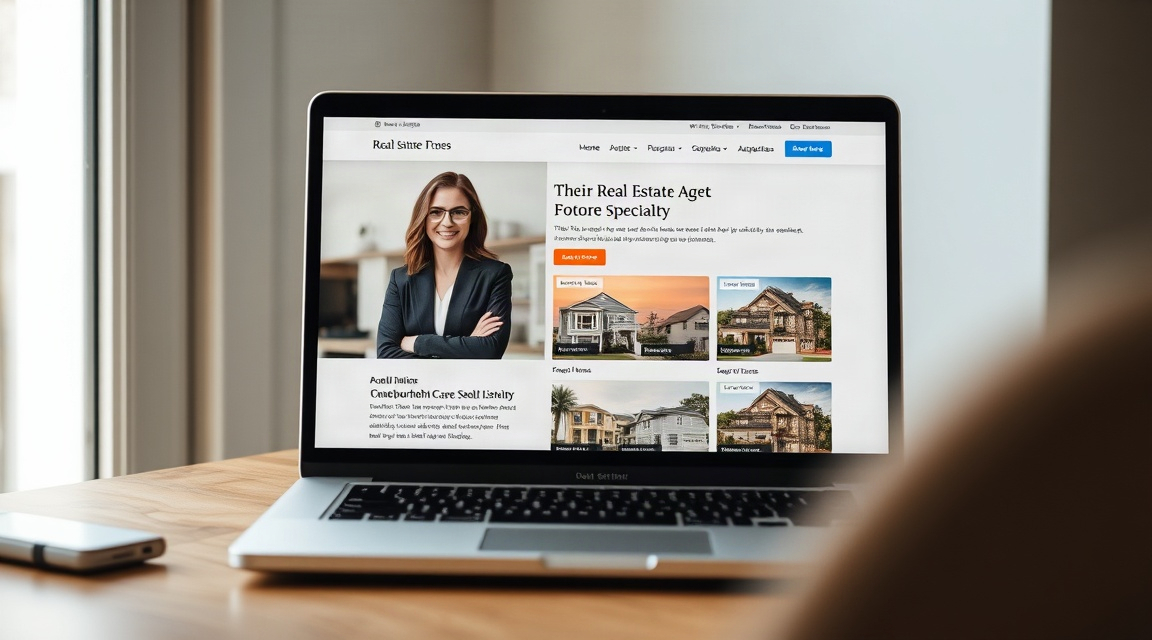 A real estate agent's website homepage displayed on a laptop, showing a headshot, neighborhood specialty, and recent sold listings
What Are the Core Elements of a Real Estate Brand?
A working real estate brand has five parts, and they need to be consistent with each other, not just individually polished.
Positioning. This is the specific claim you make: luxury condos in a particular downtown core, family homes in a specific suburb, first-time buyers, investment properties. Vague positioning ("full-service agent serving the Greater Toronto Area") is the single most common branding mistake we see, because it gives a visitor nothing to remember you by.
Visual identity. Logo, color palette, typography, and photography style. This matters, but it is the smallest lever compared to the other four. A clean, simple visual identity applied consistently beats an elaborate one applied inconsistently.
Website. Your website is where positioning, visual identity, and proof come together. It needs to load fast, work on mobile, and get a visitor to your listings or your contact form within a couple of clicks. See Web design for local businesses for what this looks like in practice for service-based businesses.
Local search presence. Your Google Business Profile, review count, and how your name and specialty appear in local search results.
Proof. Reviews, past sales figures, testimonials, and case studies. This is the part most agents underinvest in, despite it being the most persuasive to a skeptical buyer or seller.
The table below compares three common paths agents take to build these elements.
| Approach | Typical cost | Time to launch | Best fit |
|---|---|---|---|
| DIY (templates, self-managed profile) | Low, often under $500 CAD | 2 to 4 weeks | Brand-new agents testing their niche |
| Freelance designer for logo and site only | $1,500 to $5,000 CAD | 4 to 8 weeks | Agents who already have strong local SEO and reviews |
| Managed system (website, SEO, reviews, leads together) | Monthly fee, typically $200 to $600 CAD | 2 to 3 weeks | Established agents or teams who want inbound leads, not just a nicer site |
The DIY route is fine for testing positioning early on, but it rarely includes ongoing search optimization, so the site tends to sit unseen. A freelance designer produces a good-looking result but usually leaves the local search and review side untouched, which is where most of the actual lead volume comes from. A managed system ties the pieces together so the brand and the lead engine are built at the same time, which is closer to how The Found System is structured for agents and teams.
How Much Does Real Estate Branding Cost?
Costs vary widely depending on how much is bundled together. A logo alone from a freelance designer might run $300 to $1,500 CAD. A full custom website with copywriting, photography direction, and mobile optimization typically runs $3,000 to $10,000 CAD as a one-time project, or is offered as an ongoing monthly service that includes hosting, updates, and search optimization.
The more useful way to think about cost is not the sticker price but the cost per lead over 12 months. A $6,000 CAD website that sits unoptimized and generates two inquiries a year is more expensive per lead than a $300-a-month system that generates fifteen. Ask any agency for their view on lead volume, not just design quality, before committing.
Ongoing costs matter too. A brand is not a one-time purchase. Review generation, profile updates, and periodic content refreshes are ongoing work, and agents who budget for that upkeep tend to see steadier lead flow than agents who spend once on a rebrand and then leave it untouched for three years. You can see current package structures on the Pricing page for a sense of how ongoing versus one-time costs typically compare.
Pro tip: before signing anything, ask to see examples of past client websites still live and ranking, not just design mockups. A portfolio of screenshots tells you nothing about whether the sites actually generate calls.
Should You Build Your Brand Around Yourself or Your Team?
This decision shapes everything downstream, so it is worth answering deliberately rather than defaulting to whatever your brokerage template offers.
A personal brand, built around your name and face, works well for solo agents and for agents planning to stay independent for the long term. It travels with you if you switch brokerages, and it lets you build a specific reputation, for example as the go-to agent for a particular condo building or a particular buyer type. The tradeoff is that it does not scale easily. If you eventually hire buyer's agents or assistants, a brand built entirely around one personal identity can feel awkward to hand off pieces of.
A team brand, built around a name like "The [Surname] Group" or a neighborhood-based name, scales more naturally as you add agents, but it takes longer to build recognition because it lacks the immediate trust signal of a known individual. It works best for agents who already have volume and are actively growing headcount, not for someone just starting out.
There is no universally correct answer, but a reasonable rule of thumb: if you are the only person doing the selling for the next two to three years, build around your name. If you already have or plan to have multiple agents within 12 months, build the team brand now, even if it feels premature, because retrofitting a personal brand into a team brand later means starting much of the trust-building over again.
Whichever direction you choose, the practical next questions are the same: how does the website communicate that positioning clearly, and how does the local search presence support it. Our Marketing for Realtors and Real Estate Teams page walks through how those pieces fit together for both solo agents and growing teams.
Where to Go From Here
If you are working through this for your own business, the next useful step is usually not another article, it is looking at what a properly built agent or team website and search presence actually looks like side by side with your current one. The real estate marketing page lays out how the website, Google Business Profile, and lead tracking pieces are typically packaged for agents and teams in Canadian markets, and it is a reasonable place to compare against what you have now before deciding on next steps. You can also browse Our work to see completed examples, or read the Blog for more detail on specific pieces like reviews or local search.
For a general reference on professional standards and conduct that intersect with how agents market themselves in Canada, the Canadian Real Estate Association is a useful starting point.
Key takeaways
| Point | Why it matters |
|---|---|
| Branding and lead generation are the same system in real estate | A clear brand converts visibility into inquiries; a vague one wastes traffic |
| Specific positioning beats generic "full-service" claims | Visitors need a reason to remember you within seconds |
| Local search presence is now part of your brand | Buyers judge agents partly by what shows up in Google results |
| Managed systems tie website, SEO, and reviews together | Cheaper standalone options often leave gaps that suppress leads |
| Cost per lead matters more than sticker price | A cheaper site with no ongoing optimization can cost more per inquiry |
| Personal vs. team branding should match your hiring plans | Retrofitting later means rebuilding trust from scratch |
FAQ
Does real estate branding really affect how many leads I get, or is it just about looking professional? It affects lead volume directly. A visitor who cannot quickly tell what you specialize in or whether you are active in their area tends to leave without contacting you, regardless of how attractive the design is. Clear positioning and an optimized local search presence typically matter more than visual polish alone.
How long does it take to build a real estate brand from scratch? A basic website and Google Business Profile can be live within 2 to 3 weeks. Building enough reviews and search visibility to see a steady increase in inbound leads usually takes 3 to 6 months of consistent activity, not a one-time setup.
Can I rebrand without losing my existing reviews and search rankings? Yes, but it needs to be done carefully. Changing your business name, website URL, or Google Business Profile details incorrectly can disconnect your existing reviews and search history from the new brand. Any rebrand should include a plan for migrating or preserving that history, not just launching a new site.
Want the phone to actually ring?
That is the whole job. See how we do it, or tell us about your business.